Shout out to my friend Dana Boadway's Animation Mentor class! I'm staying up to write this just for you guys. Well, and for anyone else who is reading ;)
The Hold System. No one knows how it came to be, or why it exists, but it is very much a common business practice in New York (and seemingly only New York) to hire freelancers. Usually you have to find out for yourself how to handle it, or hope you have a friend to tell you, but never fear! I will explain what I know thus far about it, to hopefully help anyone who is looking to freelance at studios in NYC. Once again, if anyone has any advice to add or correct, please add it to the comments--I am speaking of what I've found to be true in my limited experience, and what I've learned from others. There is always more for me to learn.
The Call:
As I explained in an earlier post, it goes like this: Studio ABC calls you up. They've seen your reel and like it, and ask if you're available for a certain time period. You say with hidden excitement, "Yes, I am!", and they say "Great, I'd like to put you on hold for May through June."
'On hold?' You think to yourself, 'They didn't mention anything about that in my classes. All they did was tell me not to bring up the subject of money in an interview! Is this the interview? What do I say?'
"Uh, sure, that sounds good!" you say. They say great, we'll be in touch. And you hang up the phone, not knowing if you have really gotten a job or not.
On Hold vs. Booked:
A hold, as I understand, is a verbal agreement. You've told a place you are available during a certain period of time, if they call you to work for that time you have agreed to come in and work for them. The problem with this system is that it doesn't guarantee you anything until the studio actually BOOKS you. If you are *booked*, that means you are guaranteed work for the dates that they have booked you for. This is THE difference between a hold and being booked. When you're booked, you have work and you are getting paid for the dates specified. When you're "on hold", you're not working, you're not getting paid--but you may later if they book you.
Now usually a place will tell you what they want you to work on when they call you--they'll tell you what's coming up. If you get the idea or have heard about work coming up at a certain studio you are talking to, chances are they are not just calling you without any intention of hiring you. When someone calls you to put you on hold, there is probably a reason.
Therefore, if possible, you do want to try to ask them for specific dates, and when you start working to specify how long you are actually BOOKED for. This way, both parties know how long the agreed employment is and there are no surprises down the road where you thought you were guaranteed work and it turns out you aren't (though this is rare in my experience). They may not know for sure at that time, because they may still be working out their staff requirements and schedule. So be understanding of that, but still keep in touch and try to get some dates. They will most likely be in touch with you anyway when they know, so don't bug them too much. Studios know how the system works, but be sure to show that you know how it works too. Some people work up their own contracts for their freelance business, which isn't a bad idea, though I do not know much about that yet.
Competition for Hiring Freelancers:
There is competition between studios when finding freelancers. All of these studios hire from the same pool of talent in New York, and it's not as big as in California. Some places do hand out "holds" quickly and easily to a lot of people to guarantee that they will have people to work for them for an upcoming project, they may put more artists on hold than they need so they can be sure they have enough people at hand. If you find that nearly every other animator you know in the city is on hold for the same place at the same time, the studio might not need all those people. Other places only contact the number of people they know they will need. It really just depends on how that producer likes to do it, and how much manpower they need.
If you're lucky, after you finish a gig at a place, they may ask you to stay on hold for them for a few weeks more. They may know of more work coming up, or there may be unexpected changes from the client that they may need to call you back for. This is a good thing. It means that they are happy working with you, and want to continue to do business with you. But again, it doesn't guarantee work. Competition is high for animators in New York, and they don't want people they like to be snatched up by another studio, when for all they know 2 weeks later they may need you. So keep your ears open. If you've been working at a place for a few weeks, chances are you will have an idea if there actually is more work coming to the company soon, or if it's going to be a slower period. If you don't hear of more work coming up, it's not a bad idea to keep your ears open for something else. But do not take anther gig unless the studio has released you from their hold. Which leads me to the next sub-topic...
The Challenge!
To me, this sounds like it originated like one of those playground rules that kids make up when they're losing a game of four-square..."No, if it bounces twice off my foot it doesn't count...yeah-huh it's a rule!" But regardless, it is very real, and what's more, it works.
The Challenge goes like this. You have a hold at Studio-A but are not booked for that time. Studio-B calls you up and asks if you are available to work for them for the same time period. You tell them you are interested in working with them, but you are already on hold for Studio-A. But Studio-B really wants to hire you, and can BOOK you for the dates. So they say they'd like to "challenge" that hold. So you call up Studio-A and say "B wants to challenge your hold and can book me for those dates." This means that if Studio-A cannot book you for any of the dates they have you on hold for, they must release you to the other company. They will probably ask you for a day or two to get back to you. Let them, and tell Studio B that you are waiting for a response from A. If A does not get back to you on the day they said you would, you may want to call them the next day. The Challenge has a way of being drawn out, for understandable reasons. After all, if you were Studio-A you really wouldn't want to lose a freelancer who you may need when a job comes in 2 days later! But they know how the challenge works, and they themselves have likely challenged other studio's holds. I have been told that the "official" rule is that Studio-A would have 24 hours to respond. I think it is more important to stay on good terms with both companies than to hold fast to this 24 hour rule. This will put your diplomacy skills to the test, because you do not want to offend either party--you will hopefully be working for both of them again sometime, you may even have friends at both already, but Studio-B wants an answer as soon as possible and Studio-A may be trying to delay an answer for as long as possible.
If Studio-A really doesn't have any work, they will eventually release you to B, and you will be working at B for the booked dates. If Studio-A ends up having work and can BOOK you, then they "win" the challenge. It actually can be a good thing--either way, you have work. Producers I have worked with have been understanding of that too. If they really don't have any work for you, they know you need to find work for yourself.
The MOST Important Thing:
As you are dealing with such gray areas as holds, remember to treat the people you are doing business with respectfully. Some may call me naive, but I truly believe in treating others as you would like to be treated yourself, or as someone once said as they appreciate being treated. Don't back out on your holds just because you want to, or you soon won't be finding yourself working anywhere. If you run into a complication with a hold, communicate it openly to the producer you talked to. Otherwise if you take another gig somewhere else and then that first producer calls you up, you are going to have some explaining to do and it won't be fun. But honestly, if you treat people respectfully and try to realize the position they are coming from, and let them know that you recognize their position, I think you have a much greater chance of maintaining a good relationship with that producer and that company. Be aware that they know how these things work, and it is true that sometimes you will have to look out for yourself. But the last thing you want to do is offend an employer and ruin your reputation. But for me it goes deeper than saving my reputation. It's about treating others properly and respectfully. If you realize this most important thing, I think you will enhance not only your professional life, but every aspect of your life.
Monday, May 07, 2007
Wednesday, May 02, 2007
Conan at ILM
And also, here are some outtakes and shots that weren't used in the final airing (extra footage)
This was so funny, I have to post it here! We animators are proud geeks, with toys on our desks, and sometimes we don't see the light of day for hours (just ask anyone who works at Monty Hall at SCAD). So not only could I relate, but I also got to see most of those things when I interviewed at Lucas Arts, the Darth Vader and Bobba Fett costumes, the Yoda fountain are at the entry. They didn't actually show me much of the place, honestly Conan got to see more than I did, but I'm still happy I got to go there!
And finally, this post is in honor of my friends over at Lucas Arts ;) Matt, Christine, this one's for you...
Monday, April 30, 2007
"You mean you have to use your hands?? That's like a baby's toy!!"
http://news.yahoo.com/s/ap/20070430/ap_on_hi_te/mind_reading_toys
Check out this article about future toys/video games that you use your brain to play. Literally.
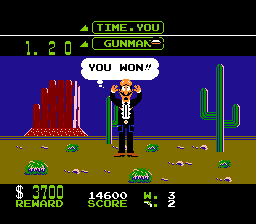
In 2015 will a little Elija Wood ask Marty McFly why you have to use your hands to play Wild Gunman?

Check out this article about future toys/video games that you use your brain to play. Literally.
In 2015 will a little Elija Wood ask Marty McFly why you have to use your hands to play Wild Gunman?

Sunday, April 29, 2007
The Stewie Worry Song
Hey, sorry it's been a couple weeks since I've posted. But I'm back!
I saw this clip on Family Guy of Stewie dancing with Gene Kelly, and found a side by side comparison video of the FG version and the orignal with Jerry Mouse on YouTube (where else?). Unfortunately the person who uploaded it has disabled video embedding :( so I'm just going to have to try to convince you to click this link!
Stewie/Worry Song
With barely any searching you can also find the full Jerry Mouse version and the full FG version.
I have to say, for Family Guy when I saw this on TV I was impressed. It's amazing how just rotoscoping the original animation, even crudely, there is so much more texture to Stewie's animation! I mean for one thing they had to draw him in poses and angles from which they never usually draw him, but it's also great to see even a hint of squash and stretch that carried over from Jerry. Don't get me wrong, I will never tout Family Guy as an example of great animation, that's not why they make it anyway. But it's an entertaining little idea, and I thought it'd be cool to post video---er, link--that shows the original too. The original was from Anchor's Aweigh.

I saw this clip on Family Guy of Stewie dancing with Gene Kelly, and found a side by side comparison video of the FG version and the orignal with Jerry Mouse on YouTube (where else?). Unfortunately the person who uploaded it has disabled video embedding :( so I'm just going to have to try to convince you to click this link!
Stewie/Worry Song
With barely any searching you can also find the full Jerry Mouse version and the full FG version.
I have to say, for Family Guy when I saw this on TV I was impressed. It's amazing how just rotoscoping the original animation, even crudely, there is so much more texture to Stewie's animation! I mean for one thing they had to draw him in poses and angles from which they never usually draw him, but it's also great to see even a hint of squash and stretch that carried over from Jerry. Don't get me wrong, I will never tout Family Guy as an example of great animation, that's not why they make it anyway. But it's an entertaining little idea, and I thought it'd be cool to post video---er, link--that shows the original too. The original was from Anchor's Aweigh.


Wednesday, April 04, 2007
Composition in Animation
During my senior year at SCAD, I had the great opportunity to take a class under Glenn Vilppu, on Classical Composition. At the time I was a little disappointed that I couldn't get into his Figure Drawing class, since that's what he's most known for, but more and more I'm so grateful that it was the composition class that I took. Hopefully at some point I can upload a pdf of my class notes, but you can go to AWN (or look for Vilppu's name in my links) and check out some of his general lessons there.
He spent almost every class analyzing some classical painting by drawing lines over top of them in photoshop (or painter or something). He talked about things like using opposites, shapes, and the flow and rhythm of a composition--as opposed to just framing. He always said that he used these principles to compose his figures too, though I didn't really understand how. Now when I study classic Disney animation and even films like The Little Mermaid I see these principles of composition in the poses all the time! My main goal in improving my skills right now is to try to really compose the characters well, with good use of negative space and movement in the pose.
I don't have time to post about it all now, but I wanted to post a link to John Kricfalusi's blog.
John is the creator of Ren and Stimpy, and although I don't share his taste for over the top Clampett style, he is posting some very informative lessons on bringing artistic principles into animation. He has a whole category of posts dedicated to composition, mostly in terms of backgrounds, but as Vilppu said, you can completely apply these to drawing characters in poses. John is pretty negative about the state of animation today, and while he makes very good points I don't quite agree with all of them. He also explains the principles of composition in different terms (I think I still prefer Vilppu's way of teaching), but regardless the ideas are the same.
John's posts on composition
The more I think about, contrasting poses, flow, rhythm and other elements of composition, the more I see that even a lot of great CG animation doesn't have it--mine included. I'm feeling more and more that these elements really push animation to a more entertaining and appealing level, and everything else really falls short of its potential, and just becomes natural movement with good timing. And the thing is, a lot of our principles of animation and design are actually based on composition, but those aren't the terms we think in.
Man...I told myself this would be 'short'. More on this later.
He spent almost every class analyzing some classical painting by drawing lines over top of them in photoshop (or painter or something). He talked about things like using opposites, shapes, and the flow and rhythm of a composition--as opposed to just framing. He always said that he used these principles to compose his figures too, though I didn't really understand how. Now when I study classic Disney animation and even films like The Little Mermaid I see these principles of composition in the poses all the time! My main goal in improving my skills right now is to try to really compose the characters well, with good use of negative space and movement in the pose.
I don't have time to post about it all now, but I wanted to post a link to John Kricfalusi's blog.
John is the creator of Ren and Stimpy, and although I don't share his taste for over the top Clampett style, he is posting some very informative lessons on bringing artistic principles into animation. He has a whole category of posts dedicated to composition, mostly in terms of backgrounds, but as Vilppu said, you can completely apply these to drawing characters in poses. John is pretty negative about the state of animation today, and while he makes very good points I don't quite agree with all of them. He also explains the principles of composition in different terms (I think I still prefer Vilppu's way of teaching), but regardless the ideas are the same.
John's posts on composition
The more I think about, contrasting poses, flow, rhythm and other elements of composition, the more I see that even a lot of great CG animation doesn't have it--mine included. I'm feeling more and more that these elements really push animation to a more entertaining and appealing level, and everything else really falls short of its potential, and just becomes natural movement with good timing. And the thing is, a lot of our principles of animation and design are actually based on composition, but those aren't the terms we think in.
Man...I told myself this would be 'short'. More on this later.
Tuesday, April 03, 2007
Conan O'Brien is not mocapped
Oh wait, I'm getting a little confused here...this will be 2 posts combined into 1!
First off, I was watching Conan last night, and one of their Conan art bumpers popped up after a commercial break--the one where the Conan head logo is the Death Star :P Those bumpers usually make me laugh, so I searched online for more and what do I find? A whole gallery of them! Fun stuff...I'm a fan of this one:
 Secondly, and on a completely different note, I've heard from different sources that there are some people who actually think the new TMNT movie was largely mocapped. Why they think this, I don't understand, because the animation is extremely exaggerated and cartoony--not to mention that I would think an actor would not want to jump across rooftops and down fire escapes to record some mocap data. It looks nothing like motion capture! Upon a google search I found a forum post by Kevin Munroe, the director himself, who confirms that not a single frame was mocapped. (scroll almost halfway down the page, post #109). He says:
So that should clear that up. The only reason why I guess people may think it's mocapped is because the physical animation looks extremely believable and accurate--if they'd look closer, they'd see the great exaggeration of weight that creates that believability. Keyframes live!
First off, I was watching Conan last night, and one of their Conan art bumpers popped up after a commercial break--the one where the Conan head logo is the Death Star :P Those bumpers usually make me laugh, so I searched online for more and what do I find? A whole gallery of them! Fun stuff...I'm a fan of this one:
 Secondly, and on a completely different note, I've heard from different sources that there are some people who actually think the new TMNT movie was largely mocapped. Why they think this, I don't understand, because the animation is extremely exaggerated and cartoony--not to mention that I would think an actor would not want to jump across rooftops and down fire escapes to record some mocap data. It looks nothing like motion capture! Upon a google search I found a forum post by Kevin Munroe, the director himself, who confirms that not a single frame was mocapped. (scroll almost halfway down the page, post #109). He says:
"Absolutely not a single frame of mo cap. All hand done. I can see why some people like mo cap, but for me, if you're doing animation, make it animated. Mocap always seems to need so much clean up and hand-holding, that you may as well have hand done it from the beginning. Just my opinion."
So that should clear that up. The only reason why I guess people may think it's mocapped is because the physical animation looks extremely believable and accurate--if they'd look closer, they'd see the great exaggeration of weight that creates that believability. Keyframes live!
Monday, April 02, 2007
"Carried Away", by Zach Parrish
Check out this short film by SCAD student Zach Parrish. I'm simply amazed at how good it is! Not only in terms of animation, but lighting, cinematography--and the story is about as good as it gets. So much warmth and heart that emotes so strongly. The sound design is great too. Man, when I was at SCAD I was happy just to get my short done, and here this guy not only gets it done, but done with a complicated bubble element, detailed facial rigging, good animation, and a story that kicks mine to the 99 cent bin at the video store! (Not that it was ever close to that, but you get my point.)
My friend Colin Geller did the beautiful matte paintings of the sky, apparently Zach did all of the modeling, rigging, texturing, and animation on his own. Way to go guys, it would be an accomplishment enough for anyone to make that film, but to do that in the crazy SCAD class schedule is an even bigger feat. Oh, and be prepared--SCAD's gonna market this just as much as "Old Man and the Fish" and "The Potter".
Subscribe to:
Posts (Atom)